Uganda Launches a National Non-formal Adult Learning and Community Education Strategy
Uganda
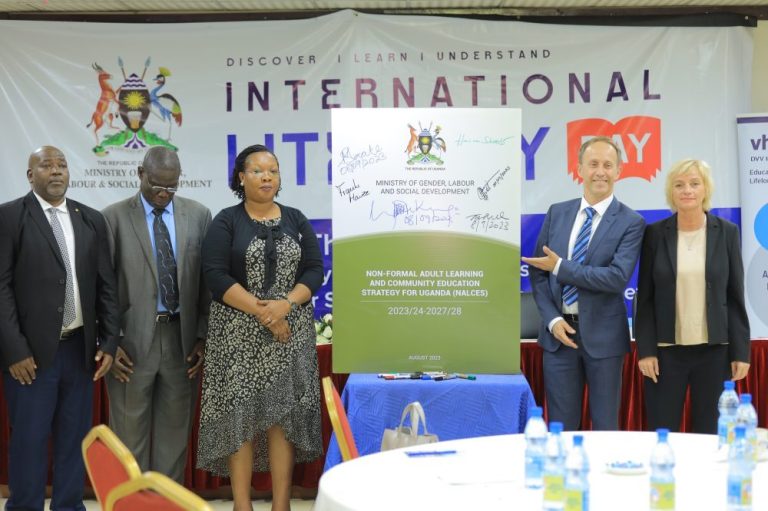
In April 2023, a stakeholder’s review meeting was convened, inviting key partners in Adult Learning and Education (ALE) in Uganda to review the draft National Non-formal Adult Learning and Community Education Strategy (NALCES). After effective consensus building at the national and district level, the Strategy was launched during the national celebration of International Literacy Day (ILD) on 8th September 2023.
Stakeholders in Uganda’s education sector, led by the Hon. Sarah Mateke, the State Minister for Youth and Children Affairs, and H.E Hans von Schroeder, the Deputy Chief of Mission at the Embassy of the Federal Republic of Germany, congregated at the Hotel Africana Kampala for a symposium to celebrate the occasion. The launch of this Strategy is a big step forward in the quest for an effective ALE System in Uganda.
The event was graced by over 150 representatives from a wide range of stakeholders, including the public sector, civil society, academia, and the private sector, as well as many individuals who advocate for lifelong learning. Notable among these were Ms. Frauke Heinze, Regional Director for East/Horn of Africa of DVV International, Mr. Charles Draecabo – UNESCO Country Coordinator, Professor George L. Openjuru, the Vice Chancellor of Gulu University, various Directors, Commissioners, and Senior Officers of different government ministries, departments, and agencies, as well as development agencies and civil society organisations. But most significantly, adult literacy learners, pupils and adult education students from various learning centres and institutions across the country took part.
The event was organized under the theme ‘Promoting literacy for a World in Transition: Building the Foundation for Peaceful and Sustainable Societies’, which was the global slogan for ILD 2023. The theme was very appropriate for the Ugandan context, where peace and forging sustainable societies are prerequisites for the attainment of the development agenda.
In his remarks, H.E Hans von Schroeder commended DVV International for their support to the Ministry of Gender, Labour, and Social Development, which has been essential to the development and launch of the Strategy, as well as the wider promotion of adult learning and education system building in Uganda. He further noted that education and development are at the core of the bilateral cooperation between the Federal Government of Germany and the Republic of Uganda that spans over decades.
He concluded that Germany continues to stand ready to support Uganda in order to help lift as many people as possible out of illiteracy and poverty, especially those who are subject to multiple forms of vulnerability, such as young girls. He expressed his hop that the Strategy will serve as an effective tool for Uganda to address urgent issues such as closing gaps in service delivery, school dropouts, high illiteracy rates, among others.
The Hon. Sarah Mateke commended DVV International and the German people for continuing their partnership with and support to the government of Uganda as it pursues its development agenda of lifting people out of poverty. She noted that illiteracy is still a big challenge in Uganda’s transition to a modern economy. She emphasised that the Government of Uganda is cognizant of the disparities in education service delivery and affirmed that it remains committed to addressing these disparities and promoting literacy as a vehicle for sustainable development. She called upon all ALE stakeholders to embrace the Strategy to guide efforts towards non-formal adult learning and community education for a literate, informed, productive, peaceful, and informed society.
The keynote address was delivered by Professor George L. Openjuru, the Vice Chancellor Gulu University, who has written extensively read on literacy and ALE. He likened literacy to other human basic needs, noting that it is essential in our daily human interactions. Without it, society cannot function, especially in today’s transitioning world that is becoming more digitalized. He expressed concerned that literacy has not been given enough attention in national development planning architecture and called for an urgent intervention by all concerned to refocus efforts to ensure delivery of the kind of literacy that today’s society needs.
Participants also had the opportunity to add their voices to the day’s discussion. Some messages expressed were as follows:
- Illiteracy is a result and product of social exclusion and injustice which can only be reversed by applying the principles of inclusion and social justice.
- The world is in transition, especially digitally. It is a big concern is that this transition is still not sufficiently reflected in literacy programming. There was a call to action for all stakeholders to embrace this transition in the design and implementation of literacy activities.
- Concerns were raised over the digital gap in society, with many people still struggling to afford basics such as textbooks and pens.
- The multi-cultural social structure in Uganda was identified as one barrier to literacy skills acquisition. 44 out of 56 national languages are still not well-integrated in the national system.
- The neglect of people with disabilities in literacy programming was also highlighted as a big challenge that needs to be addressed.
- Community Learning Centres (CLCs) were recommended as hubs for inclusive promotion of literacy and technological innovation at the local level.
Two adult Literacy learners - Christine and Christopher, a husband and wife from Nwoya District, who graduated on 5th September 2023 after a two-year integrated adult literacy course, testified before stakeholders on what it means to get a second chance to become literate at an advanced age. They were representing over 2,000 adult learners who completed their two-year learning cycle under the Integrated Community Learning for Wealth Creation (ICOLEW) Programme in Mpigi, Iganga, Namayingo and Nwoya districts. The ICOLEW Programme is implemented by the Ministry of Gender, Labour, and Social Development with support from DVV International.