Empowering Farmers: The Role of Adult Education in Applying Sustainable Agricultural Practices
Uganda
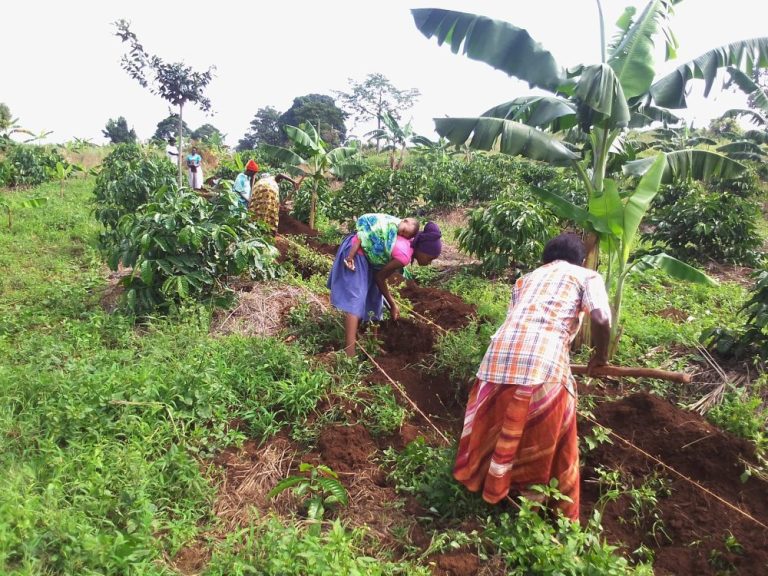
Adult learning programs equip farmers with vital knowledge and hands-on skills to adopt environmentally sustainable, climate-smart and productivity-boosting farming practices. In addition to enhancing literacy and numeracy, these programmes empower farmers to make informed choices, efficiently manage their resources, and adapt to the challenges of changing climate patterns.
The Tukole Integrated Community Learning for Wealth Creation (ICOLEW) Community Empowerment Group (CEG) was established in January 2023. The group comprises 31 members — 8 men and 23 women — united by a shared goal of improving their livelihoods through adult learning and community collaboration.
From the beginning, it became clear that low crop yields were a major barrier to the group’s development and well-being. Of the members, 18 (5 men and 13 women) were actively engaged in farming. While some were able to generate income through surplus produce, many struggled with poor harvests. Miwanda Ronald, an ICOLEW learner and LC1 Chairperson of Buzindwa village — a hilly area with steep terrain — shared how his coffee and banana production had long been unproductive due to outdated practices and poor soil conditions.
As an ICOLEW learner and the LC1 Chairperson of Buzindwa village, I have witnessed firsthand how our coffee and banana production has struggled for years. The outdated practices and poor soil conditions in our hilly terrain have hindered our productivity.
Members of the Tukole CEG have identified poor farming practices as the primary cause of persistently low crop yields in their community. This challenge is further compounded by several interconnected factors, including limited access to agricultural knowledge and training, poor soil management, land degradation, unpredictable weather patterns driven by climate change, and a lack of access to quality farming inputs such as improved seeds and fertilizers.
While low crop yields stand out as the core issue, their effects reach far beyond the fields. Families face chronic food insecurity, with many enduring long periods of hunger, particularly during the dry season or following failed harvests. With little or no surplus to sell, household income remains extremely low, making it difficult for parents to afford basic necessities such as school fees, uniforms, and scholastic materials. As a result, many children are forced to drop out of school or attend inconsistently, limiting their chances for a better future and deepening the cycle of poverty.
During their learning sessions, members gained not only literacy and numeracy skills but also practical knowledge of sustainable farming practices. These sessions fostered group dialogue, critical thinking, and collaborative planning. Together, members developed action plans to enhance productivity and conserve their land.
They committed to adopting key Sustainable Agricultural Practices such as:
- Terracing, to prevent erosion and protect soil nutrients on sloped land;
- Mulching, to retain moisture and suppress weeds;
- Shade tree planting, to reduce the impact of direct sunlight on crops and soil;
- Composting and fertilizer application, to replenish soil fertility and improve crop health.
We didn’t know the land was losing its strength because of how we were farming. Through adult education, I learned to rotate crops and use fertilizers. It’s like the soil has come back to life. (Nakanwagi Joanita, a group member)
Implementation was not left to individuals alone. The group adopted a structured rotation system in which each month, they worked together to support two members. At each garden meeting, they dug a minimum of three terraces measuring at least 45 meters each, often more for members with smaller plots. This spirit of mutual support and accountability ensured full adoption of the practices while strengthening social bonds.
It’s not just my garden that changed, it’s my mindset. I never imagined I could learn like this at my age. Now I’m even teaching my children and other community members what I’ve learned. (Miwanda Ronald, member and LC1 Chairperson)
We are no longer farming the way we used to. Now, we understand the land better and treat it with care. Our harvests have improved, and so has our hope. (Nankungo Resty, group member)
By January 2024, each member had successfully planted at least 450 coffee trees and 112 banana plants. While coffee will take up to three years to yield fully, bananas are already showing promise, with early harvests expected within the year.
The knowledge gained through adult education has not only transformed farming practices but it has also sparked confidence, cooperation, and long-term vision. Members are now passing on what they’ve learned to their families and neighbors, multiplying the impact.
For the Tukole CEG, this transformation marks a new beginning. With improved skills, strong collaboration, and a deepened understanding of sustainable agriculture, the group is building a resilient, food-secure, and self-reliant future — farm by farm, family by family.