Socially Useful and Engaged Scholarshp
Africa
Conventional or traditional research typically happens as follows: A researcher starts with a research question followed by a literature review and the development of a conceptual framework. The researcher formulates an initial hypothesis which will be tested during the course of the study in order to confirm or invalidate it. An approach to the research is decided upon and a methodology worked out. With the necessary ethical clearance, the researcher then undertakes data collection which includes interviewing/observing participants in the field and possibly desktop study (sometimes the research is purely desktop). Once the data collection is done, the researcher analyses the data and comes up with findings. The conclusion of a thesis/research report usually has a set of suggestions or recommendations.
The above approach often leads to the obtaining of a degree for the researcher and, at times, a promotion in an academic setting. Articles, mostly found in academic journals, are almost always written following the research. While the findings and recommendations may hold great value, the process is usually directive - from the researcher to the participants, with the researcher extracting from the participants what is useful to the researcher’s work. It is not really known how far and wide the findings and recommendations go, how accessible they are, and whether they result in any kind of meaningful action.
Socially useful and engaged scholarship is not the above. It takes the above and turns it on its head. Socially useful and engaged scholarship implores us to think more deeply about ‘research’ and ask important questions, such as: (a) What does it all mean for the ‘researched’? (b) How much of a part do the participants play from the beginning to the end? (c) What about beyond ‘the end’ when the thesis/report is housed on a library shelf or in a digital space? (d) What change came or will come for those ‘on the ground’? and, (e) Why did the research happen at all?
MOJA Adult Education Africa is currently hosting the MOJA AEHEAN (Adult Educators in Higher Education Network) webinar series. The focus of the series is on socially useful and engaged scholarship. There are three webinars to do with this topic, two of which have already happened. Ivor Baatjes (Canon Collins Trust) was the presenter at the first of the webinars on the August 22nd, 2024. Ivor synthesised his presentation from the work of scholars in South Africa and case studies from across the continent. The aim of this webinar (Adult and Community Education (ACE) as Socially Engaged Scholarship) was to engage adult educators, scholars, and activists in a conversation about the value of adult education as socially engaged scholarship.
As part of his presentation, Ivor raised three key points. Firstly, speaking about universities, he argued that universities do not exist above and beyond the political and social systems of a society. He pointed out that universities need to recognise that they are implicated in the crises that societies and communities face and that they should be active participants in seeking solutions to the problems that societies face. He said that:
… the university is an integral part of the local, social, political, cultural, and economic life of the communities in which it is located. Socially engaged scholarship, from this perspective, should compel us to engage with important social problems and political issues and to communicate with a larger public, upholding public values, while engaging in scholarship that is available to the communities of the university.
Secondly, pointing to an alternative conception of the university, he argued that universities need to respond to societal demands; effectively engage within their immediate habitat; and reconfigure their curricula, research, internal organisation and ways of processing ‘the intermediations of knowledge and the social’. Thirdly, he raised the importance of recognising that adult learners are socially engaged - many of whom deal with crises on a daily basis, and they actively co-construct knowledge and actions from their lived experiences and realities. In other words, they are ‘researchers’ and have the ability to do research on their own social surroundings and to use their knowledge for social change and collective and transformative praxis.
On the October 10th, 2024, Irna Senekal (Centre for Integrated Post-School Education and Training (CIPSET), Nelson Mandela University) and Enver Motala (CIPSET, Nelson Mandela University) were the speakers at the second webinar titled Building Alternatives Through Socially Useful and Engaged Scholarship. Irna and Enver discussed the concept of socially useful and engaged scholarship, pointing out that it is not the same as the ‘scholarship of engagement’. Rather than the more traditional notion of a university being some distant place/space of academic life, the presentation highlighted that socially useful and engaged scholarship is about the process of engaging with communities who are resisting oppressive and unjust systems and building alternatives developed through action emerging from their lived experience. Socially useful and engaged scholarship is about ‘constructing real relations of respectful solidarity with communities, their organisations and social movements’ in their search for social, economic, political, and ecological justice.
Socially useful and engaged research is not simply a technical process to do with trying to understand a certain situation or problem. The presenters pointed out that socially useful and engaged research embodies Freire’s notion that education can never be neutral - it must side with the materially poor, oppressed and excluded. It is about ongoing collective planning, acting, observing, and reflecting in order to learn about ourselves, our contexts and the world in which we live; and to build collective power to shift structures of oppression and exploitation to ultimately transform an unjust system into a truly humane one. To borrow from the words of Aziz Choudry, it is:
... a praxis which insists upon the unity of thought and action, contending that research and organizing in this context are mutually constitutive and that knowledge production in these movements is dialectically related to the material conditions experienced in struggles for social and economic justice.
If universities are serious about socially useful and engaged scholarship, they need to make a choice and ‘begin to have frank discussions about the aims and purposes, values and orientations of such scholarship’. Their ‘research must be quite explicit about its intention to support the mobilisation of social agency; enrich, broaden, and challenge dominant understandings of how and where education, learning, and knowledge production occur; and provide, critical conceptual tools with which to understand, inform, imagine, and bring about social change’.
Socially useful and engaged scholarship/research is not simply about the researcher/s reporting back to the participants and communities who partook in the study (this being a fair critique of how (some) academics work in an extractive way). Of course, feedback is vital and must happen. Socially useful and engaged scholarship/research is not simply about ‘closing a gap’ between the academic institution and those who live and work ‘on the ground’. Socially useful and engaged scholarship is much more than this. Socially useful and engaged scholarship asks us, implores us, requires of us to critically look at and examine the very nature of research. It asks of us to look at research not in a top-down, conventional way. It challenges and changes:
- who researches and who are ‘the researched’, dislocating the researcher as external ‘expert’ to become a co-participant involved in mutual inquiry
- who holds the knowledge and power
- who formulates the way things unfold
- who designs the methods
- who constructs the research questions
- who interprets and analyses
- what happens after ‘the end’ of the study? Who owns the results of the study and what happens next?
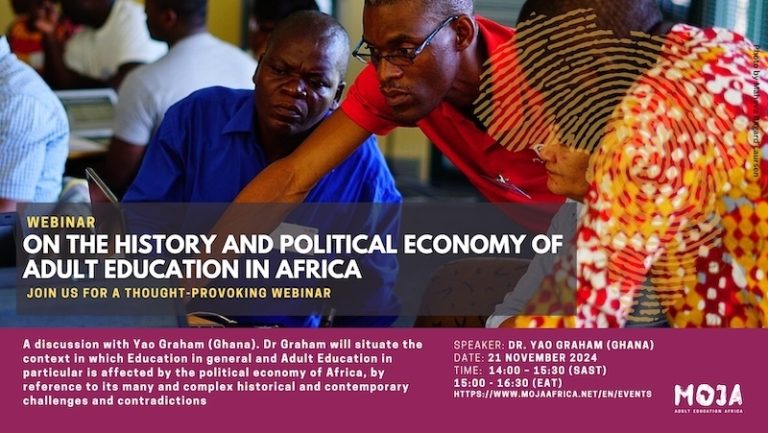
Please join MOJA for the third webinar in this series, presented by Dr Yao Graham on the November 21st, 2024: On the History and Political Economy of Adult Education in Africa. Dr Graham will situate the context in which education in general, and adult education particular, is affected by the political economy of Africa, by reference to its many and complex historical and contemporary challenges and contradictions.