Launching of the Revised ICBAE Programme: A Milestone for Adult Education in Tanzania
Tanzania
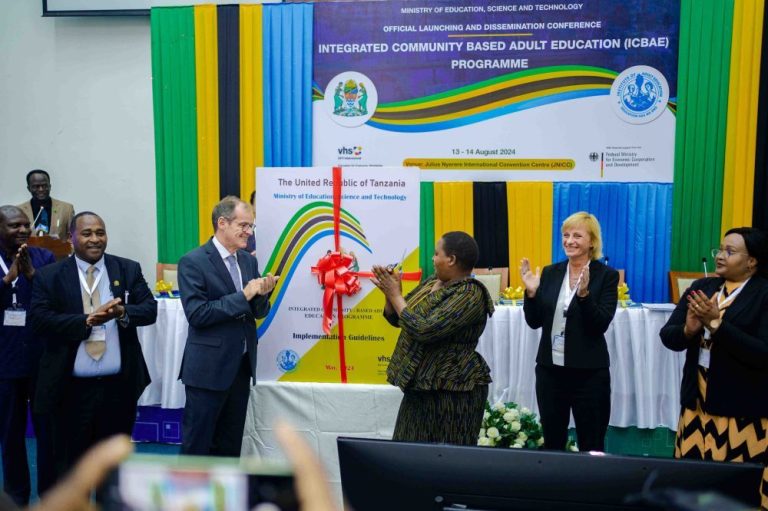
On August 13-14, 2024, a historic event unfolded at the Julius Nyerere International Convention Centre in Dar es Salaam, Tanzania. The Ministry of Education, Science, and Technology (MoEST), together with the Institute of Adult Education (IAE) and DVV International, officially launched and disseminated the reviewed Integrated Community-Based Adult Education (ICBAE) Programme Guidelines. This event marked a significant achievement in the development of adult education in Tanzania and signalled the start of the nationwide implementation of the programme in communities.
What is the ICBAE Programme?
One may ask if it’s a new programme, but it is not, the ICBAE programme was initially introduced in 1993 as a four-year pilot project aimed at developing learner-centred and community-based learning methodologies for adults and out-of-school youth. Over the years, the programme expanded across the country, striving to provide equitable access to literacy and post-literacy education. Adopting the REFLECT (Regenerated Freirean Literacy through Empowering Community Techniques) approach, ICBAE integrated literacy education with problem-solving and socio-economic development. The programme's objectives were clear:
- to promote equitable access to quality basic education
- to enhance participation, and
- to enable young people and adults to attain sustainable proficiency levels in literacy.
Despite its initial success, the programme faced challenges. Enrolment numbers, once robust, began to decline significantly from 1.2 million in 2009 to under 0.2 million in 2017. This decline prompted MoEST, IAE, and DVV International to reassess the programme and try to identify areas for improvement. Two comprehensive studies conducted in 2022 revealed that the curriculum framework, which had not been updated for nearly 29 years, needed revision to address the evolving needs of society.
The newly revitalised ICBAE Programme emphasises the need to strengthen ICBAE centres, with a key feature being the introduction of the Community Learning Centre (CLC) model. The CLC serves as a one-stop centre for youth and adult education, providing continuous education and lifelong learning opportunities that enhance personal, social, and economic development.
(Prof. Michael Ng’umbi, Rector of the Institute of Adult Education.)
To watch the speech from Prof. Ngu’mbi at the official launch of the ICBAE Programme conference, please follow this link: https://youtu.be/_nH_Ep6Ms48
A Collaborative Effort for Revitalization
The Ministry, in partnership with DVV International, has reviewed the ICBAE curriculum comprehensively. The updated guidelines stress the importance of ongoing education and lifelong learning, in line with the Sustainable Development Goals (SDGs) to strengthen the nation's educational capacity. The new ICBAE programme now includes key learning areas such as literacy and post-literacy support, life skills, entrepreneurship, agriculture, health, and pre-vocational skills development. The addition of these areas is designed to provide learners with the skills necessary for socio-economic transformation and personal growth.
The review process was informed by multiple research studies, including the "Mapping of ALE Programmes to Inform the Review of ICBAE" conducted by the University of Dar es Salaam, and a Baseline Survey on Adult Learners' Needs and Demands Assessment by Knowledge Initiative (KI). These studies highlighted the necessity of updating teaching materials, facilitators’ guides, and learning resources to meet contemporary educational needs.
Lifelong learning is a central building block for reducing poverty and infusion of equitable development in … society. But to achieve this more needs-based education, opportunities must be made available for youth and adult in the disadvantaged groups of the population.
(Thomas Terstegen, The German Ambassador to Tanzania.)
To hear the speech from the German Ambassador to Tanzania during his speech at the official launch of the ICBAE Programme conference, please follow this link: https://youtu.be/RlbuwyA6Xz0
The official day for Launch and Dissemination of the Programme Guidelines
The two-day event brought together high-level officials, including representatives from partner ministries, development partners, universities, civil society organizations, non-governmental organizations (NGOs) and Folk Development Colleges (FDC). The German Ambassador to Tanzania, Thomas Terstegen, honoured the occasion, as did the guest of honor Monica Mpululu - Assistant Director of Quality Assurance at the Ministry of Education, Science, and Technology. Other notable figures in attendance were Ms. Faith Shayo, Education Specialist at UNESCO, Ernest Hinju, Assistant Director of Special Needs, Adult, and Non-Formal Education at ADSNE, Dr. Naomi Katunzi, Council Chairperson at the Institute of Adult Education (IAE), and Prof. Michael Ng'umbi, Rector of IAE.
I believe that the ICBAE Programme guidelines I am launching today will assist adult education practitioners and professionals in effectively implementing them. Ultimately, this will lead to a nation with highly literate youth and adults who can actively participate in development activities, think critically, and solve problems within their communities.
(Hon. Monica Mpululu, Assistant Director of Quality Assurance at MOEST.)
To hear the full speech from Hon. Monica Mpululu, please click on the following link: https://youtu.be/ctd848b22s8
The first day commenced with keynote speeches that established the framework for the reviewed ICBAE programme. S. Mjangila, former Adult and Non Formal Education (ANFE) Director, emphasized the programme's ongoing significance; Dr. B. Kanukisya provided insights from foundational research, and Prof. Ng’umbi outlined the primary components of the revised guidelines. The official launch included a ceremonial ribbon-cutting of a symbolic book by the guest of honour representing the Reviewed ICBAE Programme guidelines and the presentation of certificates to the technical working group.
The ICBAE programme is a community-based programme because all its planning and learning approaches are bottom-up. This means that the community itself takes the lead in planning its development and determining the forms of learning that best meet its needs.
(Salim Mjangila, a former ANFE Director.)
The second day focused on disseminating the new guidelines and engaging stakeholders in discussions about the implementation framework and the positive impact of Community Learning Centres (CLCs). Participants engaged in gallery walks through workstations, learning about the upgraded learning areas, implementation procedures, and the role of CLCs as hubs for lifelong learning and ICBAE service delivery. These interactive sessions fostered fruitful discussions, allowing participants to gain a deeper understanding of the programme.
Moving Forward: Expectations and Takeaways
The launch of the revised ICBAE programme marks the beginning of a nationwide effort to revitalize adult education in Tanzania. The programme is community-based. The community takes charge of planning its development and determining the most suitable forms of learning to meet its needs. The programme aims to improve participants' literacy and numeracy skills, deliver education tailored to local contexts, provide vocational skills training, and foster critical thinking and problem-solving.
This collaborative effort reflects a commitment to the continuous advancement of adult education programmes in Tanzania.
(Frauke Heinze, Regional Director of DVV International East/Horn of Africa)
To hear the full speech Frauke Heinze (DVV International), please click on the following link: https://youtu.be/lRe-OZuJIOk
As the nation progresses with the implementation of the revised programme guidelines, it is essential for all stakeholders to work together to realize the vision of a literate, empowered, and prosperous society. The involvement of various stakeholders, including Ministries, development partners, civil society organizations, NGOs, and the donor community, is crucial for the successful implementation of the ICBAE programme. By adopting a learner-centreed and community-based approach, the programme aims to change lives, promote socio-economic development, and contribute to the overall growth of the nation.
Learn more about the event through the video and picture links below.
Event Video: https://youtu.be/UB-wbu2GMZU
Event Pictures https://dvv-international.pixi...