Upcoming events
No upcoming events for now
Past events
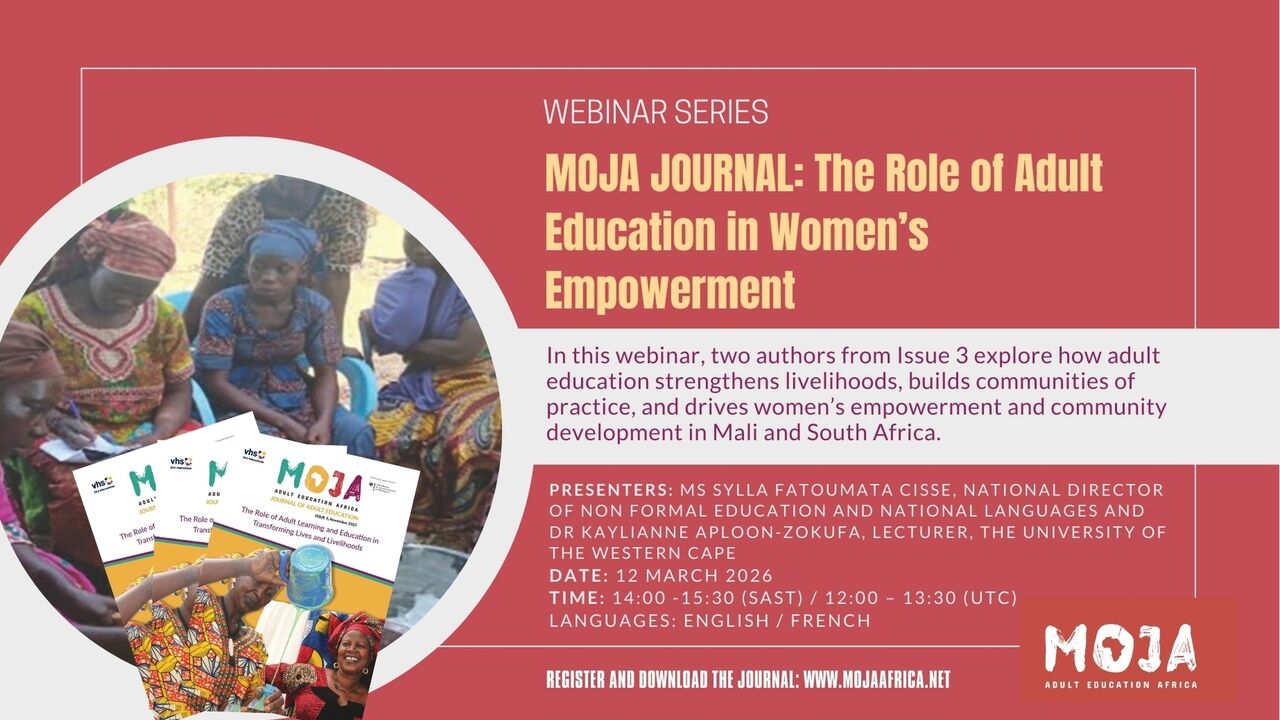
MOJA JOURNAL WEBINAR: The Role of Adult Education in Women’s Empowerment
| Southern Africa West Africa Webinar
In this webinar, two authors from Issue 3 explore how adult education strengthens livelihoods, builds communities of practice, and drives women’s empowerment and community development in Mali and South Africa.
Presenters:
- Ms SYLLA Fatoumata Cisse, National Director of Non Formal Education and National Languages
- Dr Kaylianne Aploon-Zokufa, lecturer, the University of the Western Cape
Date: 12 march 2026
Time: 14:00 -15:30 (SAST) / 12:00 – 13:30 (UTC)
Languages: English / french
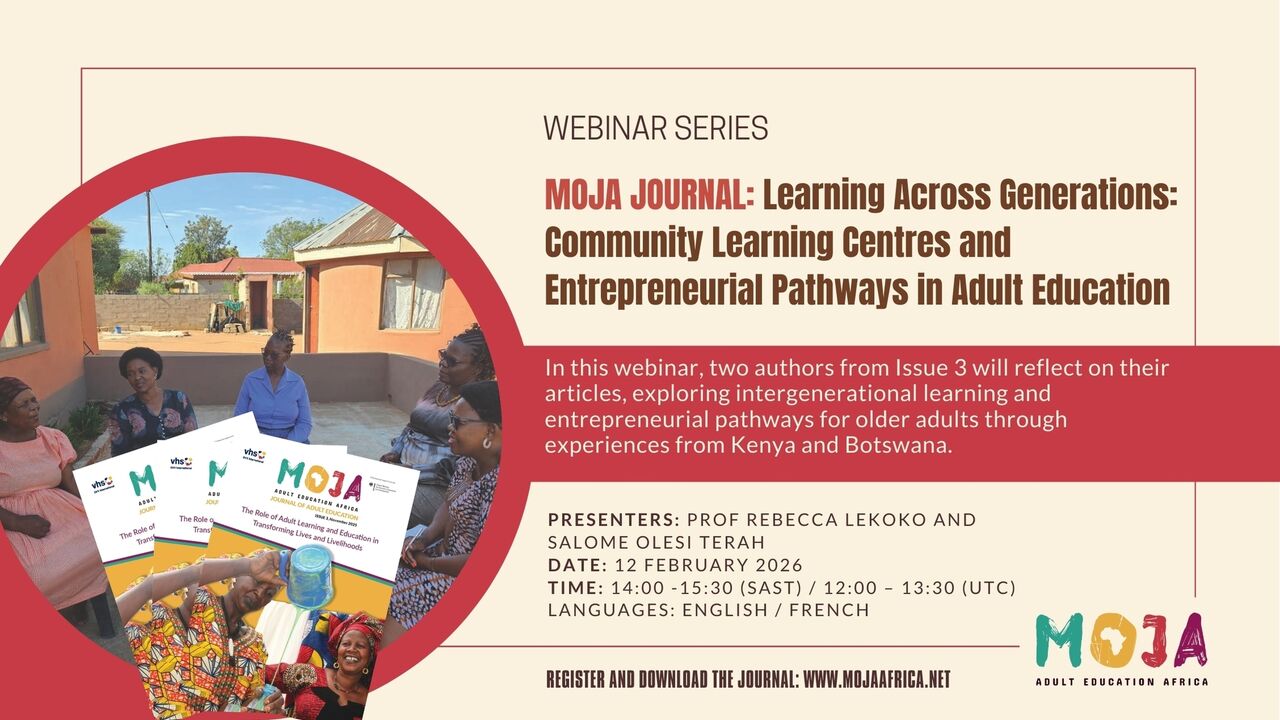
MOJA JOURNAL WEBINAR: Learning Across Generations: Community Learning Centres and Entrepreneurial Pathways in Adult Education
| Africa Webinar
English / french
In this webinar, two authors from Issue 3 will reflect on their articles, exploring intergenerational learning and entrepreneurial pathways for older adults through experiences from Kenya and Botswana.
Presenters: Rebecca Lekoko and Salome Olesi Terah
Date: 12 February 2026
Time: 14:00 -15:30 (SAST) / 12:00 – 13:30 (UTC)
Transforming Knowledge Webinar
| Southern Africa Webinar
THE POLYCRISIS OF THE POLITICAL ECONOMY, ITS CRITIQUE AND ALTERNATIVES
South Africa faces a complex, interlinked crisis that touches nearly every part of society. From deepening inequality and unemployment to the erosion of democratic institutions and ecological collapse, the effects are far-reaching. These challenges are not unique. They reflect broader global patterns shaped by decades of neoliberal policies, corporate-driven globalisation, and the weakening of state capacity in favour of market-led agendas. There is a growing body of critique that connects these issues to rising poverty, hunger, social and psychological distress, and the increasing use of militarised and authoritarian responses by powerful states. But there is also resistance. Across the country and worldwide,
communities and social movements are building alternatives rooted in care, solidarity, and justice. These efforts point to new forms of education, political organisation, and collective consciousness that can help us reimagine the future. This webinar builds on discussions from previous events and focuses on these alternatives within the broader conversation on transforming knowledge for sustainable futures.
See the advertisement attached for the booking link.

WEBINAR: Regional Africa preparatory meeting ahead of the Sixth International Conference on Learning Cities (ICLC 6)
DATE: 12 November 2024
TIME: 13:00 to 15:00 (SAST) 14:00 - 16:00 (EAT)
Background
The UNESCO Institute for Lifelong Learning (UIL), in collaboration with Jubail Industrial City, Kingdom of Saudi Arabia, a member of the Global Network of Learning Cities (GNLC), will host the Sixth International Conference on Learning Cities (ICLC 6) from 3 to 5 December 2024.
ICLC 6, like its predecessors, will provide an opportunity for GNLC members and learning city stakeholders to gather, strengthen ties and share experiences in learning city development. This year’s conference theme, ‘Learning Cities at the Forefront of Climate Action’, focuses on promoting climate consciousness and equipping local residents with the green skills needed to live in and support a sustainable society.
Participants will discuss strategies for unified climate action and explore how cities can work together to address climate change. The conference will also provide a platform for cities to exchange knowledge on climate initiatives and to showcase projects aimed at promoting community resilience to environmental crises.
The outcomes of the ICLC 6 will include an output document, outlining future policies and programmes to promote climate action in cities through lifelong learning, and a new operational strategy for the GNLC, developed through member city deliberations.
As part of the preparatory process for ICLC 6, the GNLC is encouraging members to hold regional or sub-regional meetings in advance of the conference.
Main objectives:
This regional preparatory meetings will offer an opportunity to strengthen existing regional networks or establish new ones. Held in the lead-up to ICLC 6, these meetings can provide a platform for structured dialogue and for strengthening the collaborative efforts of GNLC member cities within a UNESCO region or sub-region.
- addressing broader sustainable development issues relevant to the region, such as economic development, environmental protection, health and well-being, social inequality, poverty, migration, citizenship, digital learning, access to education and gender equality, among others, with targeted educational responses;
- collaborative efforts in the region, such as establishing regional networks, developing joint strategies and coordinating joint communications.
- agreeing on action points and to allow for assessing progress, exchanging experiences and good practices on regular basis.
Partners:
- UNESCO Institute for Lifelong Learning
- UNESCO Nairobi Office
- DVV International MOJA platform
- International Council for Adult Education/ PAMOJA
Participants:
- Learning city governmental representatives/focal persons, experts from NGO and civil society
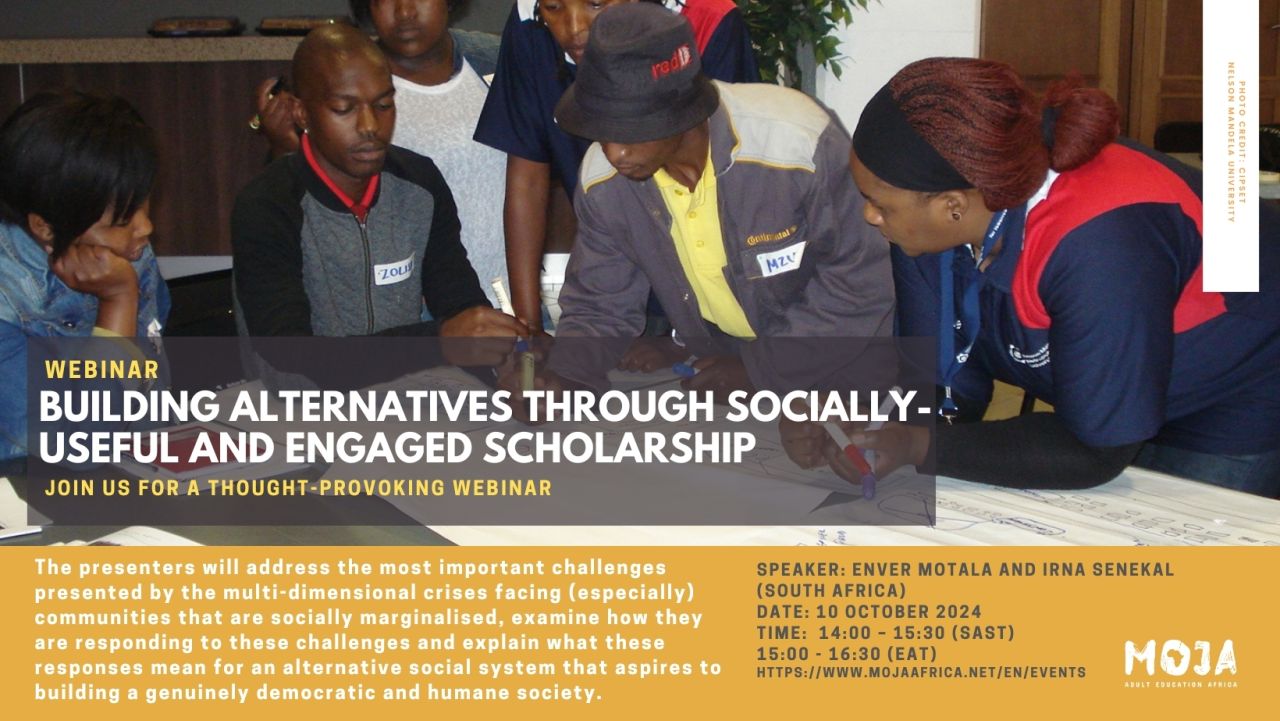
WEBINAR: Building alternatives through socially-useful and engaged scholarship
SPEAKERS: Enver Motala and Irna Senekal (South Africa)
DATE: 10 October 2024
TIME: 14:00
The presenters will address the most important challenges presented by the multi-dimensional crises facing (especially) communities that are socially marginalised, examine how they are responding to these challenges and explain what these responses mean for an alternative social system that aspires to building a genuinely democratic and humane society.
**ABOUT THE MOJA – AEHEAN Webinar Series**
MOJA, in conversation with adult educators in higher education in Africa, established a network that brings together scholars based in universities across Africa. The idea is that this network (AEHEAN) would grow across all the different regions of the continent. The main purpose of the network is to build relationships, partnerships and solidarity in adult education on the continent.
MOJA intends to facilitate and convene a series of webinar discussions. The purpose of these webinars is to support the development of the intellectual and practical capabilities of educators and their associates involved in activities relating to the study and practice of community-based learning and education on the African continent. MOJA's intention is to provide opportunities for such learning through developing the network amongst those who are involved and in the hope that the network will itself be generative of further development of these issues. MOJA believes that such a network will support the work of educators in the field, could influence their ideas and practices, their institutions and influence policymakers in this area. Most importantly it would strengthen the work of adult and community education where it is practised.
The purpose of the webinar series is:
- To stimulate a discussion about the relationship between learning, engaged scholarship and community-based education in the context of the development (or under-development) and history of the African continent.
- to provide an opportunity to educators in the higher education system drawn from countries in Africa to discuss issues which are pertinent to the work in relation to the issues referred to above.
- to stimulate a greater awareness of the contextual challenges facing communities and learning in such a context.
- to stimulate the development of thinking and the production of engaged scholarly and other forms of writing relating to these issues.
- to unearth useful writings and other materials, such as podcasts, webinars, and audio-visual materials which would be useful for the further development of an understanding of these issues.
MOJA will invite presenters who are familiar with and have experience in this area of work and distribute materials which are relevant to each webinar discussion to enable participants to engage with such materials in preparation for the webinars.
To support the purpose outlined above, MOJA is initiating a series of 3 webinars. These webinars will be facilitated by MOJA and its associates and will be rolled out over a period of 3 months. Following these, consideration will be given to the extension of the webinar series around topics that are relevant to and emerge from the initial group of webinars.
Key words associated with presentations: political economy; adult education; community education; socially-engaged scholarship; alternatives; social change; social justice; solidarity; praxis; co-constructed knowledge; climate change; community needs systems; livelihoods.
The time and date of the next webinar will be announced at a later date.

Webinar: Adult and Community Education (ACE) as Socially Engaged Scholarship
| Africa Webinar
Adult and Community Education (ACE) as Socially Engaged Scholarship
SPEAKER: Ivor Baatjes (Canon Collins Trust)
This webinar focuses on the work of scholars in South Africa and selected case studies on the continent. The focus of this webinar is to engage adult educators, scholars and activists in a conversation about the value of adult education as socially engaged scholarship. Here is a reading that you may find insightful in relation to the topic.
Date: 22 August 2024
Time: 14:00 – 15:30 (SAST) / 15:00 - 16:30 (EAT)
ABOUT THE MOJA – AEHEAN Webinar Series
MOJA, in conversation with adult educators in higher education in Africa, established a network that brings together scholars based in universities across Africa. The idea is that this network (AEHEAN) would grow across all the different regions of the continent. The main purpose of the network is to build relationships, partnerships and solidarity in adult education on the continent.
MOJA intends to facilitate and convene a series of webinar discussions. The purpose of these webinars is to support the development of the intellectual and practical capabilities of educators and their associates involved in activities relating to the study and practice of community-based learning and education on the African continent. MOJA's intention is to provide opportunities for such learning through developing the network amongst those who are involved and in the hope that the network will itself be generative of further development of these issues. MOJA believes that such a network will support the work of educators in the field, could influence their ideas and practices, their institutions and influence policymakers in this area. Most importantly it would strengthen the work of adult and community education where it is practised.
The purpose of the webinar series is:
- To stimulate a discussion about the relationship between learning, engaged scholarship and community-based education in the context of the development (or under-development) and history of the African continent.
- to provide an opportunity to educators in the higher education system drawn from countries in Africa to discuss issues which are pertinent to the work in relation to the issues referred to above.
- to stimulate a greater awareness of the contextual challenges facing communities and learning in such a context.
- to stimulate the development of thinking and the production of engaged scholarly and other forms of writing relating to these issues.
- to unearth useful writings and other materials, such as podcasts, webinars, and audio-visual materials which would be useful for the further development of an understanding of these issues.
MOJA will invite presenters who are familiar with and have experience in this area of work and distribute materials which are relevant to each webinar discussion to enable participants to engage with such materials in preparation for the webinars.
To support the purpose outlined above, MOJA is initiating a series of 3 webinars. These webinars will be facilitated by MOJA and its associates and will be rolled out over a period of 3 months. Following these, consideration will be given to the extension of the webinar series around topics that are relevant to and emerge from the initial group of webinars.
Key words associated with presentations: political economy; adult education; community education; socially-engaged scholarship; alternatives; social change; social justice; solidarity; praxis; co-constructed knowledge; climate change; community needs systems; livelihoods.
UPCOMING WEBINARS
Webinar 2: On the history and political economy of adult education in Africa
A discussion with Yao Graham (Ghana)
Dr Graham will situate the context in which Education in general and Adult Education in particular is affected by the political economy of Africa, by reference to its many and complex historical and contemporary challenges and contradictions.
Date: 4 September 2024
Time: 14:00
Webinar 3: Building alternatives through socially-useful and engaged scholarship
Enver Motala and Irna Senekal (South Africa)
Date: 10 October 2024
Time: 14:00
The presenters will address the most important challenges presented by the multi-dimensional crises facing (especially) communities that are socially marginalised, examine how they are responding to these challenges and explain what these responses mean for an alternative social system that aspires to building a genuinely democratic and humane society.

Strategies and Practices for Building Organisation and Learning to Support Solidaristic Livelihood Alternatives against the Global Polycrisis
| Southern Africa Webinar
The Webinar will explore and discuss responses to the polycrisis of capitalism through solidaristic practices focussing on a range of alternative livelihood and other socio-economic activities.
The discussion will take the form of a panel discussion between panelists from South Africa, East Africa, and the US based on their experience in this field.
Join CIPSET for a conversation with:
- Hibist Kassa - Policy Intertace Fellow at the Institute for Environmental Futures, University of Leicester, UK.
- Carol Anne Spreen - Professor of International Education at New York University & visiting professor at the University of Johannesburg.
- Angela Chukuzira - An activist based at the Ukombozi Library in Nairobi, Kenya.
Thursday 27 June 2024 at 16h00 on ZOOM.
for more information please contact Enver Motala 082 463 4189 or Ira Senekal 083 9516119

Reflecting on 30 years of democracy
| Southern Africa Webinar
The Divisions for Teaching Excellence, Institutional Planning, Evaluation and Monitoring (DIPEM) as well as Academic Development and Support (ADS), invite you to a lecture on: 30 Years of Education Policy and Practice - Looking Back and Looking Forward.
Guest Lecturer: Mr John Samuel | Respondents: Prof Salim Vally & Prof June Bam-Hutchinson
Date: 02 May 2024 | Time: 15:00 - 16:30 (South African Time)
Venue: STH, Sun International Auditorium, Bunting Road Campus, Johannesburg
RSVP: Link https://forms.office.com/r/U5z...
This event will be live streamed.
Educationist John Samuel has contributed exceptionally to public life and the well-being of society at large as a leader at the heart of South Africa’s educational development over his lifetime.
Between 1965 and 1975 he was a teacher, education administrator and policy specialist, working in the secondary and post - secondary school systems in Zambia, England, Ghana and Nigeria. In 1979 he was appointed as the Executive Director the Southern African Council of Higher Education (SACHED). SACHED developed into one of the most innovative and pioneering independent education organisations in the country in the 1980s. Building on its long and successful legacy of developing alternatives to apartheid education, SACHED pioneered new developments in such areas as publishing, distance education, mass education through the newspaper, tutorial and support work for students.
As a result of this work, he was approached to head up the ANC’s Education Department during the transition years, playing a critical role through the establishment of the Centre for Education Policy Development and Constitutional working committee in mobilising education research for change and drafting the education clauses of the Constitution.
Between 1994 and 1997 he was appointed to the first Nelson Mandela government Education Department as DDG for Education Policy and Planning, in which capacity he again played a key role in mobilising research forces and crafting new legislation to sweep away the apartheid inheritance. From 1997 he became active in the work of the Kellogg Foundation, with which he developed a programme for rural education.
From 2000-March 2006 he was appointed Chief Executive to the Nelson Mandela Foundation. Under his leadership the foundation commissioned three major national studies that influenced policy development in this country and internationally, including Emerging Voices (2003-2004). This dealt with the critical challenges of rural schooling. The work resulted in the former Minister of Education setting up a rural school forum to develop strategies to tackle these challenges. He founded the Centre for Memory that became the Nelson Mandela Archives. He also launched the 46664 Concerts, a global platform for a major Aids Awareness Campaign, harnessing the commitment and interest of popular musicians and singers from around the world.
John Samuel is a person whose contribution to education in South Africa over time has been exceptional and deserves recognition. Please attend his lecture.
Upcoming events
Past events
The Mechanisms of Consolidation of Learning for New Literacy Students
- Date: May 13, 2026
- Time: 11:30 AM - 1:30 PM (GMT)
Speakers:
- Mr. Diakaridia Diarra, Deputy National Director of Non-Formal Education and National Languages, Mali
- Mr. Amara Kone, Head of the Research and Learning Department, Directorate of Coordination and Monitoring of Literacy Programs (DCSPA), Côte d'Ivoire
WEBINAR: What is Curriculum managerALE
English / French
Join us to learn more about Curriculum managerALE and how it aims to equip adult learning managers with practical competencies to lead effectively, adapt to diverse contexts, and strengthen institutions in alignment with local needs and global ALE standards.
PRESENTERS: Dr. Johann Heilmann, Regional director, southern africa
DATE: 16 April 2026
TIME: 14:00 -15:30 (SAST) / 12:00 – 13:30 (UTC)