Upcoming events
No upcoming events for now
Past events

Training for Transformation Busy Leaders
| Global Training
Join TfT in Practice for an engaging five-day training using a participatory approach to delve into Paulo Freire’s critical conscientization and transformative development and relooking at its application to our reality.
Deadline: 14 February 2025.
Send your application form and motivational letter to info@tftinpractice.org.
Download the application form at: https://tftinpractice.org/tft-introductory-trainings/

Atelier Bilan 2024 et perspectives 2025 de DVV International - Togo
| West Africa Workshop
- Présenter le cadre contractuel avec les partenaires pour le compte de l’année 2025
- Présenter les activités réalisées en 2024
- Tirer des leçons sur les difficultés et échecs
- Partager les succès
- Définir des stratégies susceptibles d’aider à la mise en œuvre efficace des activités en 2025.

WEBINAR: Presentation and discussion of the North and Southern Africa studies on the Use of Social Media for Adult Learning and Education in Africa
| Africa Webinar
Join us for an insightful webinar reporting back on the findings of a research study on the use of social media in Adult Learning and Education across North and Southern Africa.
- Speakers: Chouaib EL Hajjaji (North Africa), Linda Daniels and Anna Weekes (Southern Africa)
- Date: Thursday, 13 February 2025
- Time: 14:00 – 15:30 (SAST) / 15:00 - 16:30 (EAT)
This webinar will be in English and French.

International Education Day Webinar ‘Lifelong learning in the age of AI’
| Global Webinar
You are warmly invited to the International Education Day webinar 'Lifelong learning in the age of AI' on 24 January 2025.
The webinar will bring together policymakers, practitioners, and researchers to revisit the idea of lifelong learning in the age of emerging technologies, with thematic focus on lifelong learning as a concept, workplace learning, digital competencies of adult educators, and bridging the grey digital divide.
Artificial Intelligence (AI) has the potential to address some of the biggest challenges in education and lifelong learning today, innovate teaching and learning practices, and accelerate progress towards Sustainable Development Goal 4. However, rapid technological developments inevitably bring multiple risks and challenges, which have so far outpaced policy debates and regulatory frameworks.
Current policies on AI and lifelong learning often adopt an instrumental and technologically deterministic approach, prioritising efficiency over human development and agency. UNESCO is committed to supporting Member States to harness the potential of AI technologies for achieving the promise of lifelong learning opportunities for all, while ensuring that its application in the learning contexts is guided by the core principles of inclusion and equity.
Objectives
- Discuss current trends, in policy, research, and innovative practices in emerging technologies such as AI and its relation to lifelong learning and the concept of agency.
- Highlight the role of adult learning and education, in fostering digital competencies with a focus on adult educators and bridging the grey digital divide.
- Engage educators and participants in interactive discussions and activities to foster a deeper understanding of AI and emerging technologies in adult education settings.
Times shown below are Central European Time.
13:00 – 13:15: Opening Remarks
Moderator: Ms Annapurna Ayyappan, Assistant Programme Specialist, UIL
- Ms Isabell Kempf, Director, UNESCO Institute for Lifelong Learning
13:20 – 14:20: Session: Lifelong Learning in the Age of AI
Moderator: Ms Rakhat Zholdoshalieva, Team Leader, Quality Learning Ecosystems, UIL
Reconfiguring Lifelong Learning in the Age of AI: Insights from policy and research
- Ms Rebecca Eynon, Professor of Education, the Internet and Society, University of Oxford, United Kingdom of Great Britain and Northern Ireland
Workplace Learning in the Age of AI: Challenges and Opportunities
- Mr Martin Dougiamas, Moodle Founder and Head of Research, Moodle, Australia
Bridging the Digital Divide for Older Adults: Lessons from Chile and Beyond
- Ms Virginia Rodés Paragarino, Research Professor on Lifelong Learning, Institute for the Future of Education – Europe, Tecnologico de Monterrey, Mexico
Capacity building: Strengthening AI and Digital Competencies of Adult Educators (new training)
- Ms Annapurna Ayyappan, Assistant Programme Specialist, UNESCO Institute for Lifelong Learning
Discussion and moderated Q&A
14:20 – 14:30: Closing remarks
Ms Isabell Kempf, Director, UIL

ELOA-Online Round Table on “Learning and Aging in Organizations"
| Global Workshop
The ELOA network offers you the opportunity to attend an online round table which is part of its upcoming conference https://www.uha.fr/fr/actualites-agenda-1/agenda/th-esrea-eloa-conference.html (Mulhouse, 15-17 Jan.)
Full Title: “Learning and aging in organizations: Transformation, transitions and research challenges FOR the next decade”.
Venue/Date: Thursday, January 16, 2025,
Time: 4:30 PM to 6:00 PM
Place: University of Haute Alsace, ENSISA Lumière, room “Petit Amphithéâtre”
Remote participation via: link<https://teams.microsoft.com/l/meetup-join/19%3ameeting_NjcwNWNkMTMtMmY2Ni00YWM2LTk5MGQtMjQ3ZjdlMGY1YjJk%40thread.v2/0?context=%7b%22Tid%22%3a%22158716cf-46b9-48ca-8c49-c7bb67e575f3%22%2c%22Oid%22%3a%2264e6467e-9887-47db-ab23-a6538c7f6351%22%7d>

Call for Papers, Special Issue on Adult Education in the Context of Work
| Global Other
The Journal for Research on Adult Education is still calling for papers for its Thematic Issue 3/2025
Abstract Submission Deadline: 15 January 2025
Paper submission Deadline: 31 March 2025
Full Call available at: https://www.die-bonn.de/docs/ZfW-CfP-03-2025-EN_31102024.pdf

First East African Conference On Recognition of Prior Learning
| East Africa Conference
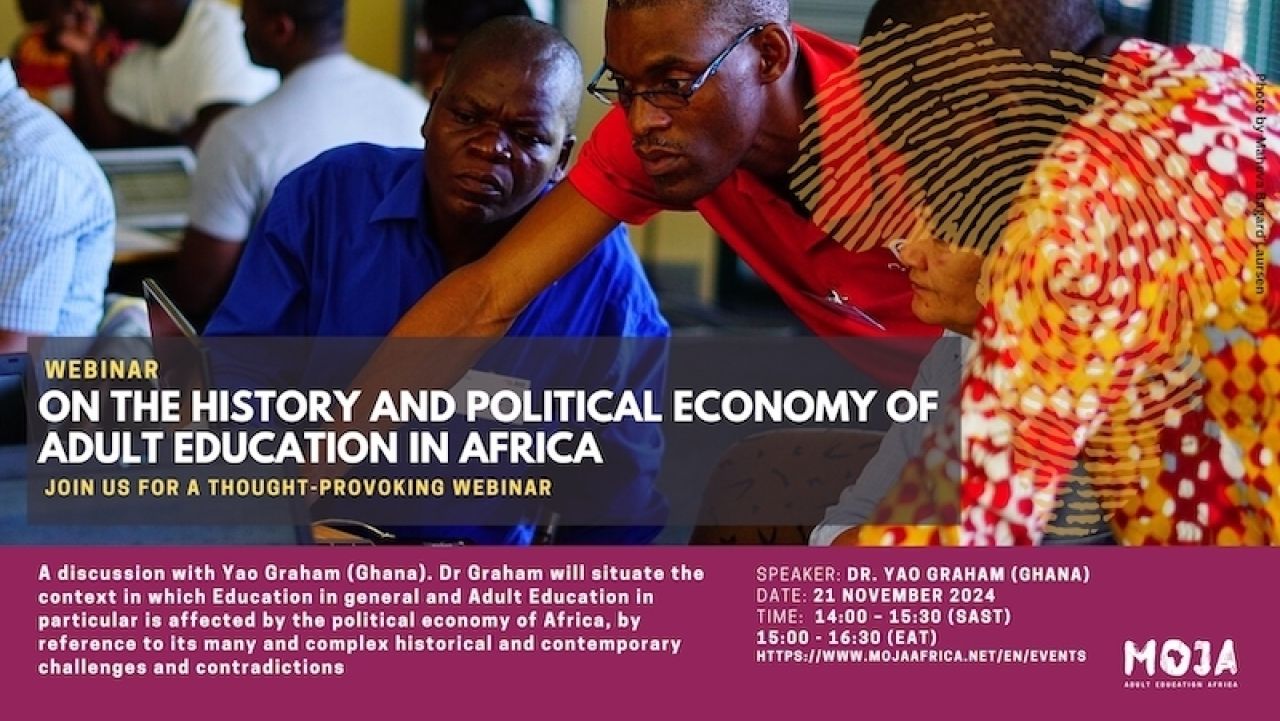
WEBINAR: On the history and political economy of adult education in Africa
| Africa Webinar
A discussion with Yao Graham (Ghana). Dr Graham will situate the context in which Education in general and Adult Education in particular is affected by the political economy of African, by reference to its many and complex historical and contemporary challenges and contradictions
Speaker: Dr. Yoa Graham (Ghana)
Date: 21 November 2024
Time: 14:00 – 15:30 (SAST) 15:00 - 16:30 (EAT)
ABOUT the MOJA – AEHEAN Webinar Series
MOJA, in conversation with adult educators in higher education in Africa, established a network that brings together scholars based in universities across Africa. The idea is that this network (AEHEAN) would grow across all the different regions of the continent. The main purpose of the network is to build relationships, partnerships and solidarity in adult education on the continent.
MOJA intends to facilitate and convene a series of webinar discussion. The purpose of these webinars is to support the development of the intellectual and practical capabilities of educators and their associates involved in the activities relating to the study and practise of community-based learning and education on the African continent. MOJAs intention is to provide opportunities for such learning through developing the network amongst those who are involved and in the hope that the network will itself be generative of further development of these issues. MOJA believes that such a network will support the work of educators in the field, could influence their ideas and practices, their institutions and influence policymakers in this area. Most importantly it would strengthen the work of adult and community education where it is practised.
The purpose of the webinar series is:
- To stimulate a discussion about the relationship between learning, engaged scholarship and community-based education in the context of the development [or under development] and history of the African continent.
- to provide an opportunity to educators in the higher education system drawn from countries in Africa to discuss issues which are pertinent to the work in relation to the issues referred to above.
- to stimulate a greater awareness of the contextual challenges facing communities and learning in such a context.
- to stimulate the development of thinking and the production of engaged scholarly and other forms of writing relating to these issues.
- to unearth useful writings and other materials, such as podcasts, webinars, and audio-visual materials which would be useful for the further development of an understanding of these issues.
MOJA will invite presenters who are familiar and have experience in this area of work and distribute materials which are relevant to each webinar discussion to enable participants to engage with such materials in preparation for the webinars.
To support the purpose outlined above, MOJA has initiated a series of 3 webinars. These, of which this is the final in the series, webinars have been facilitated by MOJA and its associates.
Past webinars in this series:
On adult and community education (ACE) as socially-engaged scholarship.
Ivor Baatjes (Canon Collins Trust)
Building alternatives through socially-useful and engaged scholarship
Enver Motala and Irna Senekal
Upcoming events
Past events
The Mechanisms of Consolidation of Learning for New Literacy Students
- Date: May 13, 2026
- Time: 11:30 AM - 1:30 PM (GMT)
Speakers:
- Mr. Diakaridia Diarra, Deputy National Director of Non-Formal Education and National Languages, Mali
- Mr. Amara Kone, Head of the Research and Learning Department, Directorate of Coordination and Monitoring of Literacy Programs (DCSPA), Côte d'Ivoire
WEBINAR: What is Curriculum managerALE
English / French
Join us to learn more about Curriculum managerALE and how it aims to equip adult learning managers with practical competencies to lead effectively, adapt to diverse contexts, and strengthen institutions in alignment with local needs and global ALE standards.
PRESENTERS: Dr. Johann Heilmann, Regional director, southern africa
DATE: 16 April 2026
TIME: 14:00 -15:30 (SAST) / 12:00 – 13:30 (UTC)